7 March 2025
The data edge in Private Equity: From acquisition to value creation
PE firms are increasingly relying on data and AI for competitive advantage. From deal sourcing to post-acquisition, investments in data maturity enhance productivity and drive value creation for PE firms and portfolio companies

As a Private Equity player, you are constantly seeking competitive differentiation. For you in identifying opportunities and conducting 'right-sized' due diligence, and for your portfolio companies in driving growth, margin and multiple expansion. Increasingly, that edge comes from judicious application of data and technology – not just having it, but knowing how to activate it effectively.
As an example, according to Bain & Company's 2025 Global Private Equity Report, nearly 20% of survey companies have operationalized generative AI use cases and are seeing concrete results. Examples include 30-60% productivity improvements for teams across the company, from developers to sales representatives. Forward-thinking funds are setting up centres-of-excellence to help give form to opportunities that these paradigm shifts bring and importantly scale capabilities internally and for portfolio companies.
Pre-Acquisition: Data as a Deal Sourcing Advantage
The importance of data starts far before any letter of intent is signed.
When evaluating potential acquisitions, savvy investors can now broaden the net of input signals and rapidly summarise these in lead scoring funnels. Both PE-specific SaaS tools and self-built workflow automation tools, coupled with proprietary and third party data sources, can be used to ingest vast quantities of information (e.g., customer reviews, website and social content, company profiles), summarise and filter opportunities meriting further investigation. By building automations tailored to their investment theses, leading PE funds identify promising acquisition targets that others might miss or approach too late.
In their 2024 report on harnessing generative AI for Private Equity, Bain and Company reference a large investor who previously looked at 10 deals for every 1 that they did a deep dive on. By embedding a set of seven criteria linked to the fund's strategy into a generative AI-driven workflow, they both build the initial target list faster and also bring down the screening time per company from a day to an hour. The combination of broad, high quality data, cutting edge analytical techniques and driving action from data boosts productivity and custs busy work significantly.
Due Diligence: Uncovering the Data Truth
During formal due diligence, data can act as a 'canary in the coal mine' for validating (or challenging) management's performance claims and growth projections. This process has evolved far beyond standard legal reviews and transaction models built from financial statements.
"The prevalence of capability gaps [particularly in Data/Management Information and IT systems/data] aligns with the discussions held during our interviews, and our own experience" explains Deloitte's survey on the role of the CFO in maximising value on exit. It goes on to mention "Finance functions are typically immature and many of the fundamentals essential to value protection are not fit-for-purpose." Nearly 90% of survey respondents agree that portfolio company CFOs' knowledge of the business and its data is among the top three aspects of their role.
If CFOs are point-persons for driving valuation uplift, data and systems are critically important to enable them, and capability gaps are highest in these areas, then it is critical to uncover the state of play during transaction due diligence so that value creation isn't kneecapped before it begins. When conducting due diligence we recommend PE funds ask key questions of the target's data infrastructure and capabilities, including:
- Does the target company have a track record of timely data availability?
- Do information flows cover the table stakes financial data, plus structured and qualitative operational data?
- Are their sales, customer, and product data integrated and internally consistent?
- What technologies comprise their data stack, and how well matched are they to the organisational culture?
- Does the company have data talent and a clear data operating model, with a clearly understood organisational structure and interfaces?
These factors increasingly impact valuation. A BCG study suggests 20-30% EBITDA gains have been achieved from data driven transformations that put fresh, granular data in the hands of sales, marketing, supply chain, manufacturing and R&D. Achieving results like this is not a due diligence question, but whether the foundation exists is.
Red flags like siloed, inaccessible data; heavy reliance on manual reporting; or the absence of a cohesive data strategy should prompt deeper investigation – not necessarily killing a deal, but influencing the investment thesis and post-acquisition planning. PE firms should carefully consider rollup strategies in cases where the target's data maturity appears low, as either the post-integration value drag can be significant, or explicit investment should be budgeted to build or import capabilities.
Common data issues we have discovered during diligence include:
- Inconsistent reporting: Different departments reporting, prima facie, the same metrics with different definitions and/or values
- Data quality problems: Missing data or duplicate records, uncertainty about source of truth operational systems and data assets
- Technical debt: Outdated or highly customised internal systems that will require significant investment to modernize or constrain hiring talent
- Unclear structure: Conflicts or gaps in data ownership, unclear reporting lines and decision authority, lack of data personnel or data-savvy management
According to Accenture's Private Equity Leaders Survey, there has been a 1.5x increase in PE firms conducting Tech due diligence, with ~80% of firms regularly or always including it in their processes. For deals that proceed, these findings shape both the purchase price and the post-acquisition strategy. Leading firms incorporate data maturity initiatives directly into their value creation plans, with clear milestones and investment requirements.
Post-Acquisition: Transforming Data Capabilities
The turmoil of economic markets in the 2020s has seen investment hold times extend, moving the focus towards sustainable value creation. Data from the Institute for Private Capital suggests a significant shift over the past decade from primarily financial engineering-based value creation towards fundamental topline growth and margin expansion. It is in these conditions that data-driven transformations for portfolio companies shine.
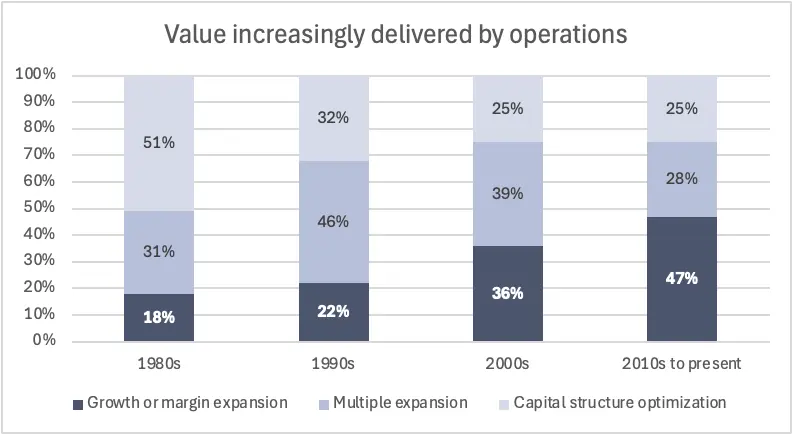
While comprehensive change takes time, targeted data initiatives can build momentum in the critical first 100 days. Initial priorities should balance short-term delivery alongside a long-term 'north star':
- Baseline assessment: Conduct an audit of major data sources, processes and systems to identify where data is being created, moved and consumed.
- Quick wins identification: Target high-value, low-effort improvements that get the right data into the hands of employees where they work. Low-code automation tools work well here, supported by use-case-specific operational reporting.
- Data operating model planning: Develop a framework for data infrastructure, organisational structure and data operations. This 'north star' should anchor incremental investments to be made as value is returned to the business from the quick wins, and balance appropriate governance with delivery at pace for the PE environment.
As a data roadmap is implemented, talent requirements can vary significantly over time. We recommend portfolio companies address this through a combination of strategic hiring, upskilling existing employees, and leveraging external partners (whether from a centre-of-excellence at the PE fund or elsewhere) for specialized capabilities and short term needs.
Benefits for Both PE Firms and Portfolio Companies
For PE firms, robust data capabilities deliver multiple advantages:
- Enhanced deal flow: Proprietary data assets help identify promising targets before competitors
- Better investment decisions: More accurate valuation and clearer visibility into improvement levers
- Accelerated value creation: Data-driven operational improvements drive EBITDA growth faster
- Higher exit multiples: Companies with mature data capabilities typically command premium valuations
For portfolio companies, the benefits extend beyond the investment horizon:
- Operational excellence: Real-time visibility into key performance indicators enables continuous improvement
- Customer insights: Better understanding of customer behavior drives product development and sales effectiveness
- Strategic clarity: Data-backed decision making replaces gut instinct and political considerations
- Competitive advantage: Data maturity becomes a sustainable differentiator within the industry
Uplift for portfolio companies can be significant. A McKinsey study on digital procurement in Private Equity indicated that firms taking a bold and comprehensive approach, supported by the new digital and analytics tools, can lift EBITDA by 20% within six months. Perhaps most importantly, uplifts in data maturity outlast the PE investment period and support higher exit multiples.
Conclusion
As competition for quality assets intensifies and multiple expansion becomes less reliable as a value creation lever, data capabilities will increasingly separate leading PE firms from the pack.
For PE firms, your fund stage and maturity will guide whether initial data initiatives naturally fit in the (pre-)transaction phase or post-acquisition phase. For portfolio company management teams, there is no better time than now to take stock of the data environment for your business and assess whether it supports or hinders you in the hunt for long-term enterprise value.
At Cruxdata, we help Private Equity firms and their portfolio companies leverage data as a strategic asset throughout the investment lifecycle. From pre-acquisition data diligence to post-acquisition transformation and ongoing analytics support, our team brings both technical expertise and business acumen to deliver measurable value.
Ready to turn data capabilities into a competitive advantage? Contact us to discuss how we can support your specific needs.